ON THE NON-LINEAR ARCHIVE
An Explanation of Why the Lapidary’s Records Do Not Have Consistent Dates, and What the Lapidary Has Concluded From This
Lapidary of the Interior — Foundational Series — Vol. VI Classification: INTERIOR / UNRESTRICTED Issued: [non-linear]
THE OBSERVATION
People who read carefully through the Lapidary’s documents — the case files, the field reports, the research notes — will notice that almost none of them have reliable dates. Dates are listed as “non-linear” or “approximate” or are absent entirely. Field reports are filed at an interval after the event that the report itself describes as uncertain. Documents reference each other without establishing a clear sequence.
This is not an error in the record-keeping. The Lapidary has tried to keep precise dates. The imprecision is a finding.
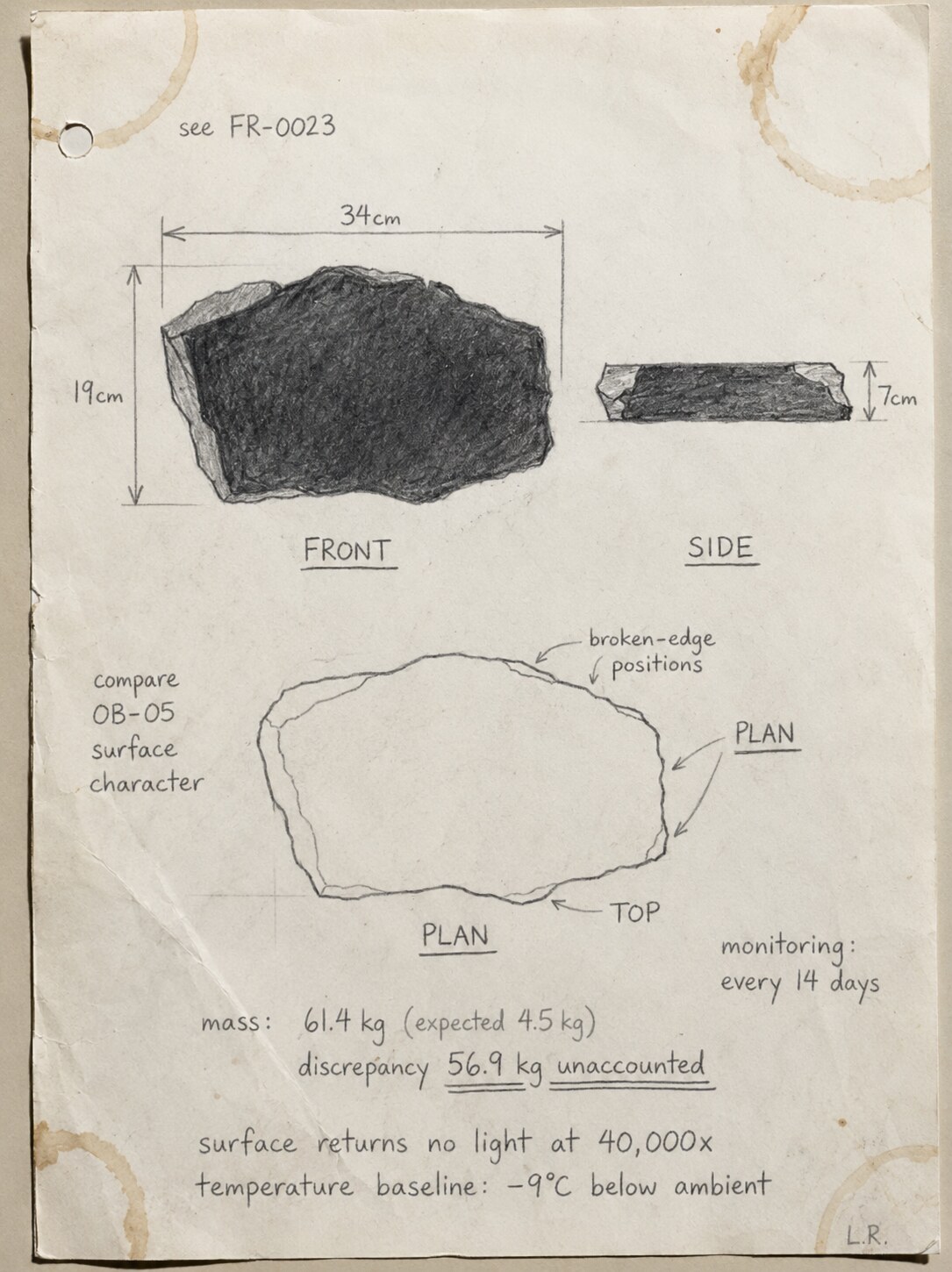
Figure: A representative field observation page. This volume includes one illustration because the question of when a record was made is the question this volume exists to address — and the page above, like most pages in the Lapidary’s working archive, does not answer it.
THE HISTORY OF THE LAPIDARY’S ATTEMPTS AT DATING
When the registry was established, the Lapidary maintained records with standard date fields. Events were logged with timestamps. Documents were filed with the date of creation. The register was organised chronologically.
This practice lasted for what the Lapidary estimates — with the caution that estimate implies — as several years.
During this period the Lapidary noticed that the dates in its records did not always survive contact with the material. Not that the records were altered. The records remained. But certain events, when the Lapidary attempted to establish their sequence, produced contradictions. A field report would reference a conversation that, by the date record, had not yet occurred. A case file would note an observation from a monitoring visit that the monitoring equipment’s timestamp suggested had taken place eighteen days later than the file indicated. A holder would describe an event as occurring “before” another event that the Lapidary’s records placed prior to both.
The Lapidary investigated these contradictions. It did not resolve them. The records were genuine. The contradictions persisted.
WHAT THE LAPIDARY HAS CONCLUDED
The Lapidary has concluded — with the caution it attaches to all conclusions — that the material has a relationship with time that is different from the relationship most physical objects have with time.
This is an unusual conclusion. The Lapidary is aware of this. It has not reached it quickly or without alternatives.
The alternatives the Lapidary considered and rejected:
Record-keeping error. The Lapidary reviewed all the contradictions for evidence of simple administrative error — incorrect dates entered, documents misfiled, timestamps set incorrectly on monitoring equipment. Some of the contradictions had this explanation. Not all of them did. The contradictions that remained after administrative error was excluded are the ones the Lapidary is attempting to address in this document.
Memory and perception errors. Holders and representatives are human. Humans misremember sequences. The Lapidary considered whether all the temporal contradictions could be explained by unreliable human memory. They cannot. Several of the contradictions involve independently maintained records from multiple parties whose accounts contradict each other in ways that human memory error does not typically produce — specifically, in ways where each party’s account is internally consistent but inconsistent with the other’s, and where the contradiction is not about what happened but about when.
Unusual but explicable physical phenomena. The Lapidary considered whether there are known physical phenomena that could produce apparent temporal inconsistencies in proximity to an unusual material. It did not find a satisfactory candidate. The fragments are cold and heavy and non-reflective, but these properties do not, under any physical framework the Lapidary could find, produce effects on the temporal sequencing of events in their vicinity.
What remained, after these alternatives were excluded, is the conclusion the Lapidary has reached: the material’s relationship with time is different.
WHAT THIS MEANS FOR THE RECORD
The Lapidary records what happened. When it happened is, in relation to the material, a question the Lapidary has found it cannot answer with the confidence the question seems to deserve.
This is why the documents in this archive say “non-linear” where they would otherwise say a date. Non-linear is not a date. It is an acknowledgment that the date the Lapidary would write might not accurately represent the sequence in which the event sits. The Lapidary prefers “non-linear” to a date that implies a precision the Lapidary cannot support.
The Lapidary has maintained dates where it can maintain them with confidence — where events are far enough from active fragment contact that the temporal uncertainty does not apply, where multiple independent records agree on sequence, where the date is a matter of calendar time rather than fragment-proximate time.
These dates can be trusted. The Lapidary marks them simply with a date.
Where the Lapidary writes “non-linear,” the reader should understand: something happened, and this is the account of it, and the account is accurate, and when it sits in relation to other events is a question the Lapidary cannot answer without misrepresenting its certainty.
THE EARLIEST DOCUMENT IN THE ARCHIVE
The earliest document in the Lapidary’s archive references a document the Lapidary has not found. The document it references is described as “the prior record” — as if there was already a record before the record began, and the earliest thing in the archive is itself a continuation.
The Lapidary has looked for the prior record. It has not found it.
The Lapidary notes that the archive begins in the middle of something. The beginning of that something is not in the archive. The Lapidary is not certain the beginning is findable. It is possible the material has been here longer than any record the Lapidary can access, and that the history of its encounters precedes any written account.
It is possible the first record was not written down. It is possible the first record was written and is now among the things the void has received and not returned. It is possible the first record is elsewhere and the Lapidary has not found it.
The archive accumulates from somewhere in the middle. The Lapidary adds to it. The middle extends. The beginning remains out of reach.
A NOTE ON WHAT THE NON-LINEARITY MIGHT MEAN
The Lapidary has resisted, throughout this document, making strong claims about the implications of what it has observed.
It will make one here, framed as possibility rather than conclusion:
If the material has a non-standard relationship with time — if events in its proximity do not always arrange themselves in the sequence that a clock would suggest — then it is possible that the Lapidary’s archive contains information about events that, in ordinary temporal terms, have not yet occurred.
The Lapidary has found, more than once, a document in its own archive that describes something it does not remember recording and that seems to describe a situation it has not yet encountered. In each case the situation was subsequently encountered. The document was then consistent with what had happened.
The Lapidary does not know if it is recording the future, or if the future is arranging itself to be consistent with its records, or if the perception of temporal sequence near the material is simply unreliable in ways that occasionally produce this coincidence.
The Lapidary is filing this as an open observation.
The Lapidary notes that it has been filing things as open observations for a long time.
The Lapidary continues.
Lapidary of the Interior Office of the Primary Record lapidaryoftheinterior.org Issued: [non-linear]